WebScrapingAPI Review: 68% Success Rate, $2.04/1k Across 11 Targets (2026)
In Scrapeway's latest benchmark (September 2026), WebScrapingAPI achieved a 68% overall success rate across 11 target websites, ranking #3 out of 7 tested APIs, with an average response time of 17.7s and a cost of $2.04 per 1,000 requests.
WebScrapingAPI is a web scraping API publicly available since 2021 offering scraping API and managed scraping services.
WebScrapingAPI is the tool that carries out the heavy lifting when it comes to web scraping. We’ve dedicated ourselves to creating a user-centric API, focusing on meeting the developers' needs and the businesses they support. So, stop worrying about proxies or headless browsers, and focus on what you need - data. Let's not forget, enjoy our stories and discover with us the incredible experience of web scraping.
Overall WebScrapingAPI performs well with Scrapeway's benchmarks showing it to be a good value when it comes to bypassing common anti-bot measures.
However WebScrapingAPI offers an incredibly limited feature set making it unsuitable for many scraping scenarios where any request customization is needed. This makes WebScrapingAPI a tough choice for anything but the simplest scraping tasks that require anti-bot bypass.
To address more complex web scraping scenarios WebScrapingAPI offers "Browser API" product for automating browser tasks but it's not covered by Scrapeway as it's not a web scraping API.
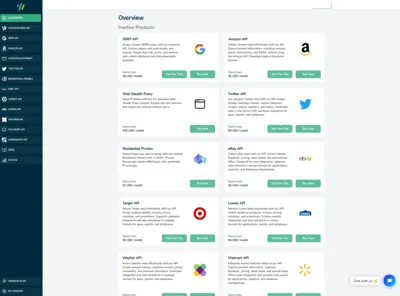
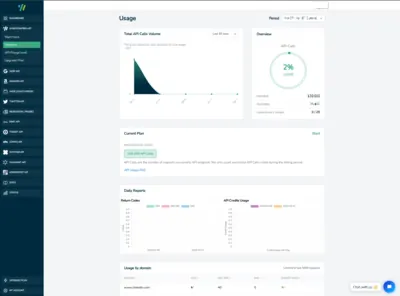
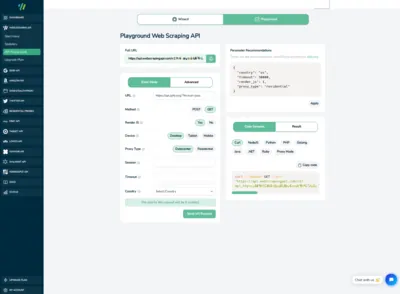
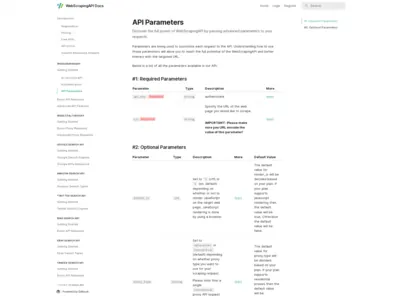
- Good scraper blocking bypass.
-
Simple pricing structure
1 request == 1 credit, always. - Low entry point of $19.
- Integrations for NodeJS, Python, Java, Rust, Scrapy and PHP.
- Optional Javascript rendering for scraping dynamic pages.
- Web UI player for testing and experimenting.
- Does not charges for blocked requests.
- Extremely limited feature set — no request header and other basic request customizations.
- Static 1 credit pricing leaves no room for pricing optimizations.
- Programming integrations are relatively basic and outdated.
- Significantly slower than competition.
- Credits do not carry over month-to-month.
How WebScrapingAPI compares against other web scraping APIs in success rate, speed and cost.

- WebScrapingAPI has an above-average success rate of 67.5% vs industry average 54.2%
- WebScrapingAPI has a below-average speed of 17.7s vs industry average 9.3s
- WebScrapingAPI has a below-average price of $2.0/1000 vs industry average $2.8
Per-target benchmark results from our latest report.
WebScrapingAPI Pricing
WebScrapingAPI is a credit-based service where each scrape request costs exactly 1 credit while avoiding charging on failed or blocked requests. This makes the pricing very simple and easy to understand but it also leave no space for optimizations.
| Plan | Price | Credits | Concurrency |
|---|---|---|---|
| Started | 19 | 7,000 | 20 |
| Basic | 49 | 20,000 | 20 |
| Standard | 99 | 45,000 | 50 |
| Advanced | 149 | 100,000 | 100 |
| Premium | 249 | 180,000 | 200 |
| Pro | 599 | 450,000 | 500 |
Overall WebScrapingAPI pricing can be very competitive, especially when it comes to harder to scrape targets, but it can become quickly expensive for high volume, multi domain scraping.
WebScrapingAPI Features
Overall, WebScrapingAPI offers a very limited features compared to competition as it focuses on simplicity with another product - Browser API - focusing on browser automations which can include scraping. Unfortunately, this leaves out even basic features like custom headers, cookies, and user agents making the service unusable for many scraping scenarios.
| Feature | Availability |
|---|---|
| Integrations | Python, Scrapy, NodeJS, Java, PHP, Rust |
| Proxy support | Datacenter default, Residential optional |
| Geolocation | 12+ countries |
| Webhook support | No |
| Javascreipt rendering | Yes, at extra cost |
| Custom JS evaluation | No |
| Browser control | Yes, predefined actions like scroll, click, input |
| Screenshots | Yes, full page and individual elements |
| Sessions | Yes, persistent IP for 5min |
To add, WebScrapingAPI offers some unique features at no extra cost included with every plan:
- Extraction Rules can be used to parse HTML as JSON using XPath or CSS selectors.
- Json DOM can be generate which converts page HTML to a JSON structure.